
SwingAnalyzer bets that vision-capable LLMs can meaningfully evaluate athletic swing mechanics — the project exists to benchmark which models are actually useful for that task.
The core shipped work is a multi-model evaluation harness built in Swift and TypeScript that runs a two-pass locate-then-refine pipeline against any OpenRouter vision model, then assembles a 3×3 contact sheet per model/video pair. An independent vision judge scores each sheet 0–10, and the system emits the sheets, a markdown leaderboard, and a results.json in a single run — making model comparison systematic and reproducible.

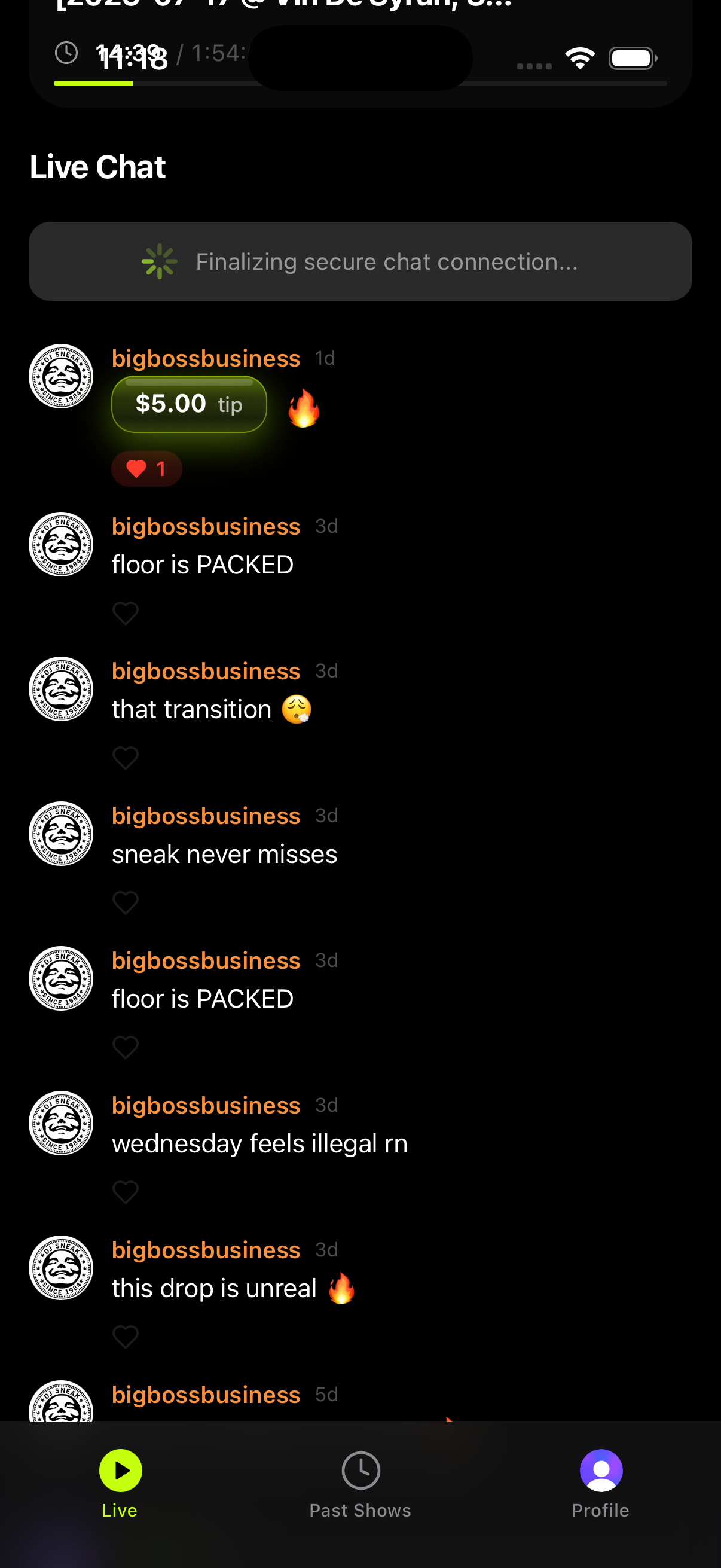
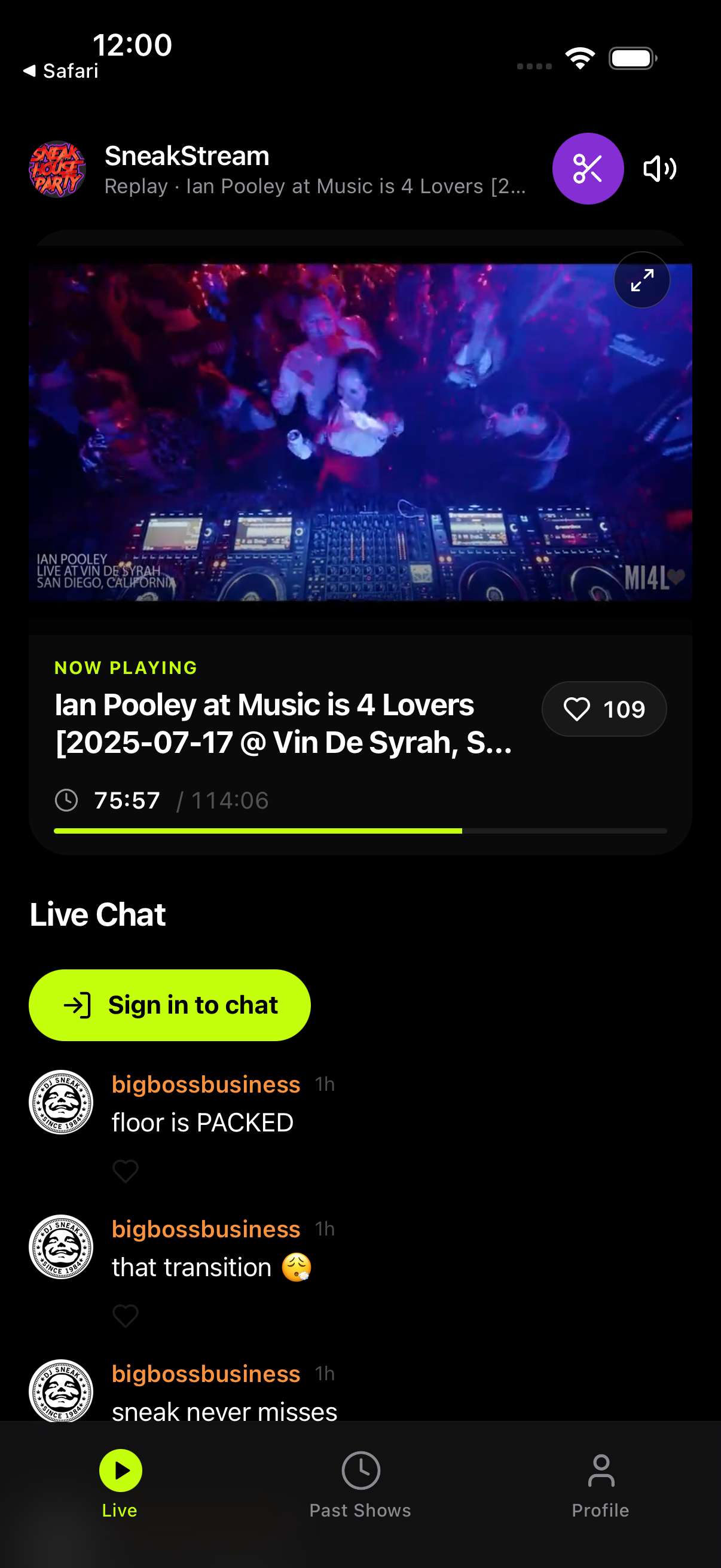
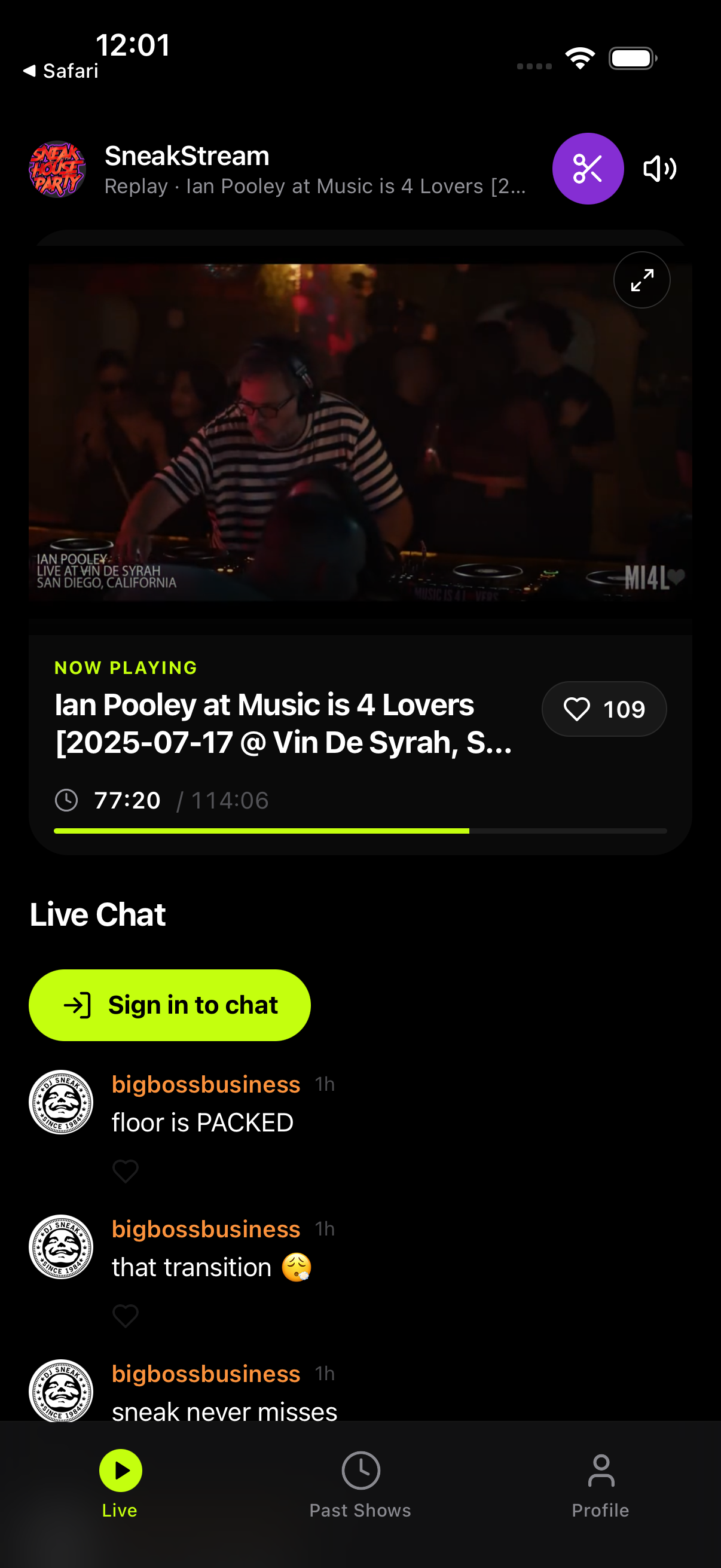
SneakStream is a DJ-focused live streaming platform built to replace generic video infrastructure with a purpose-built experience: synchronized broadcast playback, pay-per-view gating, real-time chat, and a mobile app — all tuned for the specific rhythms of nightclub and DJ culture.
The platform ships a Next.js web frontend backed by Convex, supporting live RTMP streaming via Mux or Livepeer, clock-synced 24/7 radio, a VOD library with HLS delivery, auction-based track-crate purchases, Apple IAP for tips and PPV unlocks, and a party-photo capture-to-gallery loop with QR-based guest sharing. An Expo React Native app covers iOS and Android with feature parity including chat, clips, PPV, and GIF/emote support. Recent work has concentrated on App Store compliance (UGC moderation, account deletion, IAP receipt verification), production hardening (webhook deduplication, brownout recovery, HEIC transcoding), and a fully animated iOS Dynamic Island Live Activity that surfaces stream state and replay position without user interaction.





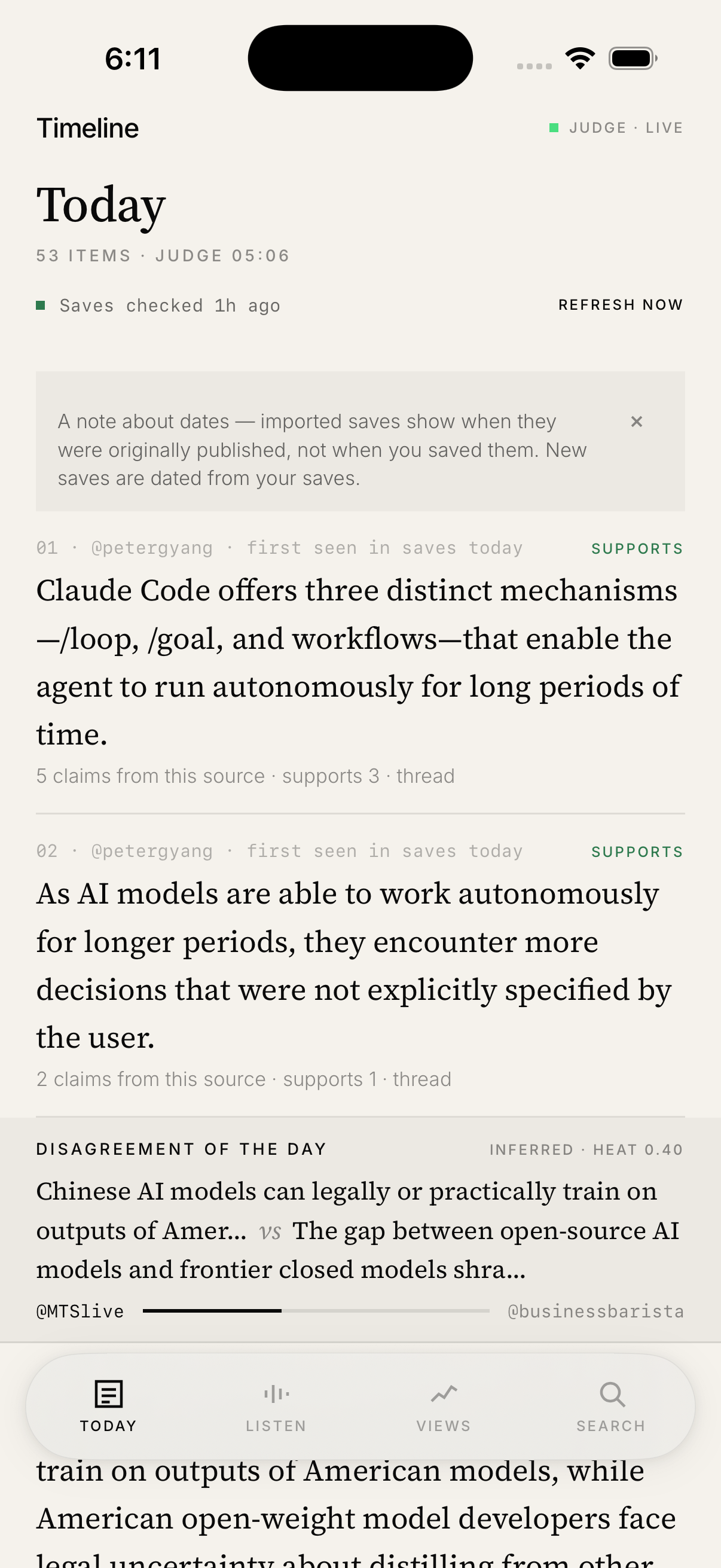
compact is an experiment harness and diary system for tracking shipped work, betting that structured deduplication and rich media replay can turn a raw commit stream into a reliable, browsable record.
The core harness gained a post-hoc merge pass that collapses duplicate beat entries across source units and re-grades survivors, cutting commit-granularity entries by 34%. On the display side, diary entries with multiple screenshots now render as a 2×2 tile cluster with a shot-count badge, opening into a full lightbox with arrow navigation, a thumbnail strip, and keyboard shortcuts.
OpenParent is a family accountability system that uses an AI judge to evaluate household interactions—captured audio exchanges—against a configurable rubric, then translates those judgments into a consequence ledger visible to both parents and children.
The core shipped work is a full consequence pipeline: audio is captured, speaker-verified on-device via cosine similarity, scored by a rubric-driven LLM judge, and routed through a deterministic safety rail that enforces magnitude clamps, rate limits, and daily caps before writing to the ledger. Recent focus has been on parent control surfaces—a pending-proposals inbox, event drill-down with Apply/Skip actions, an in-browser simulation console, and versioned editors for both the rubric and policy config—alongside a secrets-free Convex test harness with comprehensive coverage of the consequence rail and ledger logic.
vibe-debug bets that coding agents debug better with real runtime state than with static source reading — the project exists to give agents a proper DAP-backed Python debugger they can drive programmatically, rather than guessing from tracebacks.
The core deliverable is an MCP server that exposes breakpoints, stepping, and live locals inspection as structured tool calls, letting agents launch a repro script and interrogate actual runtime state. Distribution friction was addressed with an npx shim so no Python tooling is required to register the server with Claude Code. The project then expanded in two directions: a stream-json formatter for watching Claude debugging sessions in real time, and a standalone CLI mode with an init command that writes a project-level skill file so agents can discover and invoke the debugger without MCP at all.
AllyBi is a video-statement platform built for both web and mobile, with the core bet that authenticated, user-owned video content requires a robust, cross-platform identity layer from the start.
The shipped work spans a full Clerk-backed auth system across web and mobile: eight branded web screens covering sign-in, sign-up, MFA, SSO, and invite flows, plus a mobile-native FAPI client using secure-store JWTs with an AuthGate routing layer. Recent work has tightened the mobile experience specifically — wiring real Google/Apple OAuth flows, adding a phone-collection screen for OAuth sign-ups missing that data, implementing SMS OTP for two-factor sign-in, and delivering a JWT-gated /api/videos/me feed so signed-in users see only their own content across both apps.
WineMail is a personal wine management app built on the premise that a wine enthusiast's inbox, cellar, and palate can be unified into a single AI-augmented tool — turning merchant emails, PDF receipts, tasting notes, and label photos into a queryable, rankable, and recommendable wine collection.
The app ingests wine data from Gmail (via OAuth), uploaded PDFs, and label photos (including video), then structures it into inventory, offer, and diary records backed by Supabase. Over time the focus has expanded from data capture and display into AI-heavy workflows: async Celery tasks handle OpenAI-powered ranking, FAL-based bottle image generation, web-search shop discovery, food-pairing recommendations via OpenRouter, and a 'Tonight' picker with curated nightly lenses — all coordinated through Redis and S3. Most recently, the project extended outward via a dual-protocol MCP server exposing the full wine dataset to Claude Desktop and ChatGPT Apps as interactive card-grid widgets.